
Book Gnu · Featured historical finds
Joseph Dow: Hampton History
A printed address. A lifetime of handwritten history.
An annotated nineteenth-century volume, loose research papers, and the continuing story of a collection found far from Hampton, New Hampshire.
Explore all 102 photographs ↓ · Watch the volume walkthrough ↓
Explore the related eBay listing
View the Joseph Dow listing on eBay →
Affiliate disclosure: As an eBay Partner Network affiliate, GNUWHIT may earn a commission from qualifying purchases made through this link.
History between the printed pages
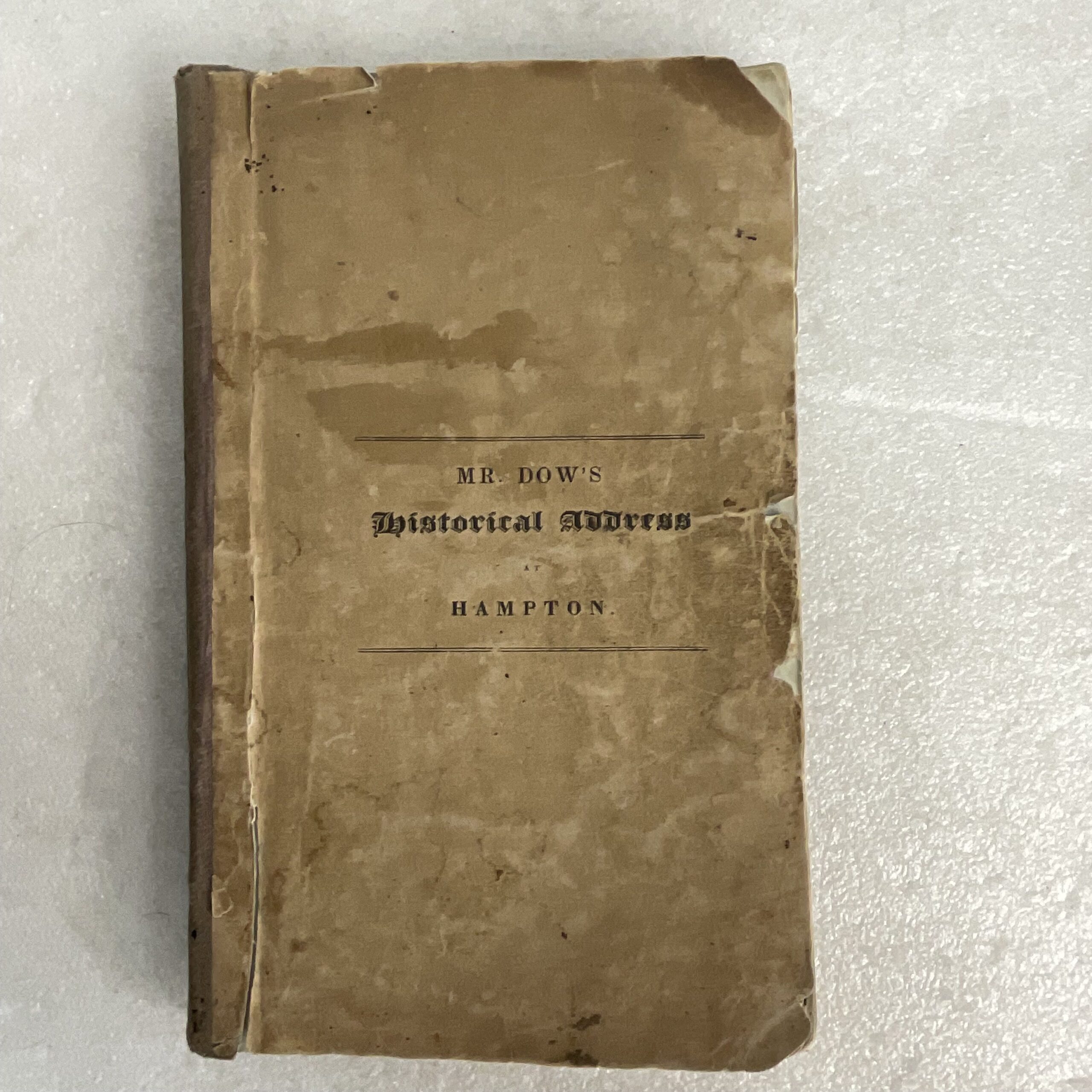
This is not simply a photographed copy of an old book. Printed leaves sit beside manuscript additions: copied records, names and dates, corrections, references, tables of town officers, and loose pieces of paper saved for further work. Together they offer a close view of how Hampton’s history was gathered, compared, and revised.
The title page identifies the work as An Historical Address, delivered at Hampton, New-Hampshire, on the 25th of December, 1838, commemorating two hundred years since the town’s settlement. It names Joseph Dow, A.M., as author and records printing by Asa McFarland in Concord in February 1839. The Huntington Library’s catalogue independently records the same published work.
Joseph Dow, historian and genealogist
Joseph Dow (1807–1889) devoted substantial effort to Hampton’s history and families. A Dartmouth graduate and teacher, he later concentrated on historical research. His work continued far beyond the 1838 address; his daughter Lucy Ellen Dow brought his larger history to publication in 1894 after his death. Lane Memorial Library’s biographical account provides the fuller story.
The photographed material ranges across topography, land and settlement, town government, constables and treasurers, military service, local names, churches, education, and family history. Later-dated additions and correspondence show that this copy’s story did not end when the printed address appeared.
A collection with a journey of its own
Whit reports finding this volume as part of a larger collection of historical papers and a chest. He identifies the principal manuscript additions as Joseph Dow’s handwriting. This feature preserves the present volume and its accompanying loose material; the portrait, broader records, and chest photographs are now presented in the separate Joseph Dow trunk archive.
Part of the larger collection made its way back to Hampton. The Hampton Historical Society’s “Dow’s Trunk” exhibit account tells of a wooden trunk marked “J. Dow, Hampton, NH” found through an abandoned Idaho storage unit. Its July 2018 newsletter describes the Tuck Museum’s acquisition of a trunk and hundreds of documents associated with Joseph and Lucy Dow.
A careful distinction: those institutional accounts concern the returned trunk and documents. They do not establish that this particular annotated volume is held by the museum. The collection connection and handwriting attribution here are supplied by Whit; this feature is documentation, not an independent handwriting authentication.
What to look for
Start with the printed title page, then compare the typeset address with the surrounding handwritten leaves. Look for amendments, cross-references, source citations, and long lists of officers. The loose papers include a Whig political ticket reused for notes, a constitutional propositions ballot, newspaper clippings, a character-reference fragment, and an 1867 letter addressed to Joseph Dow requesting a transcription from Hampton records.
Not every hand need be the same: an incoming letter, a copied historical quotation, a printed clipping, and an author’s working annotation are different kinds of evidence. Dates written in notes may refer to the historical event being copied rather than the date the note was written.
The documents retain historical language and viewpoints, including references to Indigenous people, colonial conflict, religion, and witchcraft accusations. They are presented as historical sources for examination, not as endorsements of their language or claims.
Turn the pages with us
The complete approximately 25-minute walkthrough is presented in three consecutive parts to fit the website’s upload limit. No section of the walkthrough has been intentionally omitted. The web copies are compressed; the original video has been preserved separately.
Walkthrough · Part 1 of 3
Walkthrough · Part 2 of 3
Walkthrough · Part 3 of 3
The complete photo archive
All 102 supplied photographs are included across six linked galleries, with 17 images per page. The sequence preserves the photographed progression through the book and its inserts. Covers, close-ups, repeated views, loose documents, and end matter remain part of the record.
Two more finds from the same collection
Whit confirms that the two documents already featured here also came from this collection. Their individual stories remain available:
Sources & the continuing record
Historical context: Lane Memorial Library biography; Huntington Library catalogue; Hampton Historical Society trunk exhibit; HHS July 2018 newsletter. Object photographs, video, collection relationship, and attribution supplied by Whit. Inventory reference: GNU 6315 Y26.
This is a growing photographic record. Transcriptions, additional provenance, and images of the larger collection and chest can be added as they become available. Uncertain readings and authorship should remain open to research.